Say No To Nanny

Smokefree Ideology


Nicotine Wars


40 Years of Hurt

Prejudice and Prohibition

Road To Ruin?

Search This Site
The Pleasure of Smoking

Forest Polling Report

Outdoor Smoking Bans

Share This Page
Powered by Squarespace
Saturday
Oct012022

GTNF 2022

Two abiding memories of GTNF 2022.

One, the first keynote speaker on day one of this tobacco industry event was Deepak Mishra, president of the Americas region at Philip Morris International (PMI).

Mishra told delegates he had given up smoking in 2016 and hadn’t had a cigarette for six years. He then raised his arms in a small gesture of triumph and got a round of applause.

Honestly, it was like stumbling into an AA meeting.

Two, the first keynote speaker on the second day was Adam Afriyie, the Conservative MP for Windsor who is vice-chair of the APPG on Vaping and was once described as a ‘potential future Tory leader’.

When he wasn’t banging the drum for Britain’s regulatory approach to tobacco control, Afriyie was praising Javed Khan’s recent review.

The report, he said, had been "very well received". The standout issues, he said, were that vaping must be front and centre of the drive to get rid of smoking, and the need for more education about vaping among the healthcare establishment.

Unfortunately, alongside Khan’s perfectly reasonable endorsement of vaping as a safer alternative to smoking are some batshit crazy ideas including raising the age of sale of tobacco by one year every year until no-one is allowed to smoke.

Afriyie chose not to mention that. Nor did he mention Khan's recommendation to extend the smoking ban to beer gardens and other outside areas.

Instead he gave the impression that he supported every loony toon in the Javed Khan songbook. (He told me later he didn’t but that’s another story.)

He finished his speech by urging smokers to “Please stop for society", adding, "Do move on”, which I found quite patronising.

That in essence however was the underlying message of GTNF 2022. Smoking is history, tobacco harm reduction is the future.

I’ve no quibble with the latter ambition as long as it doesn’t involve further restrictions and regulations on smoking, but I do find it odd to find myself, if not alone, then fairly isolated when it comes to defending smoking at what is arguably the world’s leading tobacco industry conference.

After I criticised Philip Morris (for calling for a ban on the sale of cigarettes in the UK by 2030) in a panel discussion about prohibition, a handful of people said well done but always privately and never within earshot of anyone else.

It was done almost furtively - a quiet word in a lift, for example, or hotel corridor. I didn’t know these people and I shall probably never see them again, but their words were welcome nonetheless.

Next year’s GTNF is in Seoul, South Korea, which has been talked about as a potential location for several years.

I’d love to go - I’ve never been to that part of the world - but I sense that after twelve years my time at GTNF May be coming to a close.

When a session called ‘Forgotten Smokers’ makes no mention of consumers who enjoy smoking and don’t want to quit (the most forgotten group of all), focussing instead on smokers who are being denied the opportunity to switch to vaping, you know your time is almost up.

Nevertheless it was nice to meet several people I have read about but never previously met, notably Marewa Glover, Tim Andrews and Guy Bentley. Look them up.

PS. Before I left I was invited to meet Adam Afriyie. It was a private meeting so I can’t say more but it’s public knowledge that he’s stepping down as an MP at the next election to return, he says, to business.

His former chief of staff, Russell Walters, now works for Philip Morris UK. What are the odds on his former boss joining him?

Pure speculation on my part but you read it here first.

Update: Conference wise the funniest moment at GTNF 2022 had to be the rapid departure of another keynote speaker, Brian King.

King is director of the US Food and Drug Administration’s Center for Tobacco Products and the FDA is currently involved in a lengthy process concerning the regulation of e-cigarette products in the US.

The GTNF audience - which included many companies and individuals affected by this Kafka-esque procedure - was told that King would take questions at the end of his speech.

Somehow he managed to extend it so that, when he finished, oh dear, there was no time for questions because he had to dash off to his next appointment.

And in a flash, like the Scarlet Pimpernel, he was gone.

See also:Is prohibition back?

Wednesday
Sep282022

Is prohibition back?

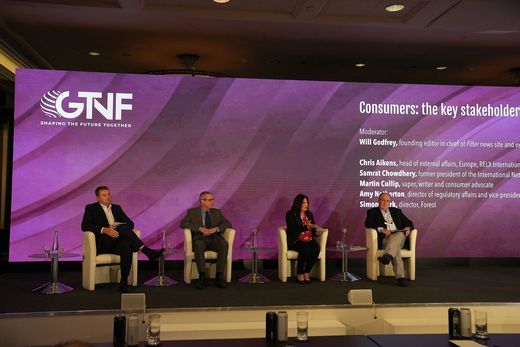
At the Global Tobacco and Nicotine Forum in Washington yesterday I was one of five speakers on a panel that addressed the question, ‘Is prohibition back?’.

Other speakers were trade law consultant Abrie du Plessis; Kgosi Letlape, former president for the Health Professions Council of South Africa; Riccardo Polosa, full professor of internal medicine at the University of Catania and founder of the Center of Excellence for the Acceleration of Harm Reduction; and the IEA’s Chris Snowdon.

After the late afternoon session we moved upstairs to the rooftop terrace on the ninth floor of the Hay-Adams Hotel for the ‘Welcome Reception’. As you can see (above) the terrace overlooked the White House and Washington Monument. Not a bad view.

Anyway here’s my initial four-minute contribution to the earlier discussion:

In answer to the question ‘Is prohibition back?’, prohibition - or the threat of prohibition - has never gone away.

What was once called the temperance lobby at the start of the 20th century merely reappeared under the guise of public health and devised a new strategy - creeping prohibition. The goal is still the same but it’s long-term rather than short-term.

In relation to tobacco, prohibition is nothing new because there has been clear evidence of creeping prohibition for decades.

For example, public smoking bans are a form of creeping prohibition because they severely restrict where people can smoke and in many countries even designated smoking rooms and booths are prohibited. Since banning smoking in all indoor public places, we’ve seen many examples of smoking bans being extended to outdoor public places, and even social housing, prohibiting people from smoking in their own homes.

Bans on menthol flavoured cigarettes are an example of an entire category of cigarette being prohibited. In the UK menthol cigarettes represented over 20% of the cigarette market, and they’re now gone - prohibited.

Meanwhile there are plans in America to not only ban menthol cigarettes but to limit nicotine levels in cigarettes, effectively prohibiting cigarettes as consumers currently know them.

Another example of creeping prohibition can be seen in New Zealand where the government plans to ban the sale of tobacco to anyone born after 2008, while in the UK a recent report commissioned by the government recommended that the government raise the age of sale of tobacco by one year every year until no-one is allowed to smoke.

Meanwhile governments in England, Scotland, Wales and Ireland have all set targets by which they want their countries to be ‘smoke free’, by which they mean fewer than 5% of the adult population smoking.

From a consumer perspective the problem with these smoke free targets is that they are difficult if not impossible to achieve without further (and excessive) regulation, and that often means prohibition and punitive taxation which is a more subtle form of prohibition, effectively pricing consumers out of the market.

As for prohibition, that should never be the answer to the problems caused by tobacco. The outcome would almost certainly be the opposite of that intended. The product will be driven underground, illicit cigarettes manufactured to far less exacting standards will become the norm, and that will put consumers including children at even greater risk.

Moreover, if we accept prohibition - or even ‘smoke free’ - as a legitimate goal we effectively hand autonomy of our bodies over to government and a puritanical health lobby that will never stop dictating how we live our lives.

Talking of prohibition I also want to raise an interesting or disturbing development. A couple of years ago Philip Morris called on the UK government to ban the sale of cigarettes in England by 2030. This year in Scotland the UK’s leading vape retailer launched a campaign urging the Scottish Government to ‘Ban smoking for good’.

The point I want to make is that by actively promoting the prohibition of cigarettes and smoking, these companies are effectively legitimising and normalising the idea. It’s also, I would argue, self-defeating because the day will surely come when alternative nicotine products including e-cigarettes will also be targeted for prohibition, as indeed they already are in some parts of the world.

Alternative approaches to tobacco harm reduction should clearly focus on extending consumer choice and allowing companies to promote and sell reduced risk products as harm reduction devices.

But the onus is not only on governments to adopt a light touch regulation policy on vaping and smokeless products, the industry can also help by developing better reduced risk products that appeal to more smokers because there is no question that many current smokers don’t want to switch because they don’t like the reduced risk products that are currently on the market as much as they like cigarettes.

So instead of calling for a ban on cigarettes, as Philip Morris has done in the UK, the industry should fight prohibition and focus on improving e-cigarettes and other reduced risk products like heated tobacco so they appeal to more smokers - and of course government must allow them to market and promote those products so they appeal to current smokers.

Tuesday
Sep272022

GTNF - here we go again

It’s always nice to be back at GTNF, the annual tobacco (and nicotine) conference, although it’s also true that fings ain’t wot they used to be.

When GTNF was launched in 2008 (in Rio) it was called the Global Tobacco Networking Forum and vaping was still in its infancy so I don’t know if it even got a mention.

I didn’t go to Rio but I’ve attended every GTNF (bar one) since - Bangalore (2010), Antwerp (2012), Cape Town (2013), West Virginia (2014), Bologna (2015), Brussels (2016), New York (2017), London (2018) and London again (2021).

The exception was Washington in 2019. I can’t remember why I didn’t go but I assume it was because of my (self-imposed) rule that if I’m not invited to speak I won’t go because it’s not worth the money if I’m only there to make up the numbers.

I’m sorry if that sounds self-important but rules are rules! Truth is, as the representative of an unfashionable cause (smokers’ rights) I’m holding on by my fingertips and I have to take a stand.

The last GTNF I can honestly say felt pro-tobacco took place in Cape Town in 2013 when our hosts, led by some plain speaking South African tobacco farmers, made their views very clear.

‘Stop apologising’ seemed to be their message and as I remember, and wrote at the time, it was rather refreshing.

The following year, in West Virginia, I was given - for the first and only time - a keynote speech to talk about Forest and our work but even then the agenda was changing in favour of speeches and presentations about tobacco harm reduction and reduced risk products.

To be clear, I have no problem with the industry evolving in that direction as long as the interests and choices of confirmed smokers are acknowledged and respected and to be fair, while they may be marginalised, GTNF has never completely abandoned them, unlike every other tobacco or nicotine-related conference.

Anyway, at some point in the last ten years (I can’t remember which year) GTNF changed its name to the Global Tobacco and Nicotine Forum. It may have been 2015, the year we went to Bologna, because I remember sitting next to another delegate - from America - who was obviously perplexed that anyone would want to defend smoking.

I felt like saying, ‘You do know this is a tobacco industry event?’, but it was obvious even then that I was in an increasingly small minority of delegates who were prepared to say anything in defence of smoking.

Nevertheless even I was surprised when in 2017 the PMI-funded Foundation for a Smoke Free World was launched at GTNF in New York. Not even Lewis Carroll could have made that up.

Anyway here I am at GTNF 2022 and this year I’m speaking on a panel that will address the issue of prohibition.

The session however is not part of the main conference that begins at the Four Seasons Hotel tomorrow. Instead we’re like the warm-up act, one of three afternoon sessions before the Welcome Reception at the Hay-Adams Hotel this evening.

It will be filmed though so there should be an opportunity to watch it, and all the other sessions, at a later date. I’ll keep you posted.

In the meantime here are some of my favourite GTNF moments. They stand alongside some of my best memories of working for Forest:

Bangalore (2010): Our arrival at our seven-star hotel at six o’clock in the morning following an eleven-hour flight is a moment I shall never forget as rose petals were showered on our heads by staff standing on the mezzanine above the spacious reception area. My large luxurious room lived up to the warm welcome and even better was the covered outdoor bar where we gathered for drinks. The Australian cricket team was staying there too and after the conference was over I spent an afternoon at the Bangalore Test match in the company of journalist Mick Hume, founding editor of Spiked. How we weren’t killed crossing a busy main road on our return to the hotel remains a mystery.

Antwerp (2012): Without question, this was the most bizarre conference location ever. Overnight delegates stayed in one of two hotels but the actual conference took place on board two boats that spent the day (and much of the evening) at sea, and there was no escape! On the second day we were advised to take our passports and all became clear when we found ourselves in a small town in the Netherlands where we were given a guided tour followed by a street party in our honour. Extraordinary.

Cape Town (2013): Regrettably, in hindsight, I saw relatively little of the city because having been warned at length of all the terrible things that might happen if we left the security of the hotel compound I erred on the side of caution. Nevertheless I had a wonderful view of Table Mountain from my room at Mount Nelson Hotel (named after Horatio not Mandela) and I enjoyed the post conference excursions to some of the local vineyards. The whale watching? Not so much.

West Virginia (2014): The conference venue was The Greenbriars, an enormous almost Gothic building (and golf resort) in White Sulphur Springs, a small town in the middle of nowhere - four hours by road from Dulles Airport, Washington, or six hours by rail. Unforgettably, the welcome reception took place inside a nuclear bunker that had been built beneath the hotel in the Fifties so that, in the event of a nuclear strike on Washington, Congress could continue the business of government underground. The bunker remained a secret until 1992 when it was exposed by the Washington Post.

See also: GTNF 2012 - The highs and lows
Out of South Africa - GTNF 2013
Greetings from the Greenbrier - GTNF 2014
Pork chop at a bar mitzvah - reflections on GTNF 2015
Mandela, moon landings and JFK - GTNF 2017

Sunday
Sep252022

Washington memories

I’m currently in Washington DC for the annual Global Tobacco and Nicotine Forum (GTNF) that begins on Tuesday and runs until Thursday evening.

I arrived early because I hate travelling long distances to conferences and then flying straight back without having a chance to explore the city or country where the event is taking place.

I normally adopt my tourist hat after the event but the Conservative party conference starts next Sunday so I have to get home because Forest is hosting a fringe event on the Monday.

Anyway, I’m pleased to be here.

This is my fourth visit to Washington. The first was in 1983, the second in 1987, the third in 2014 following another GTNF conference in White Sulphur Springs, West Virginia.

In 1983 I was one of 20 young European journalists invited to attend a two-week event organised by the Young America’s Foundation, a conservative youth organisation with close links to the Republican Party.

In 1983 Brian Monteith, who later became Forest’s spokesman in Scotland and later still an MSP and then an MEP for the Brexit Party, was chairman of the Federation of Conservative Students.

Even in those days Brian and I knew each other and he kindly put my name forward as one of three UK representatives.

I knew exactly what I was letting myself in for (two weeks’ indoctrination!) so I was prepared to put up with the propaganda in return for a chance to visit the White House, the Capitol, the Smithsonian and the Washington Monument.

Some delegates however took umbrage and walked out of several ‘lectures’ - which I thought was a bit precious if not ungrateful!

We went in April which, weather wise, seems to be a great month to visit Washington as winter turns into spring.

I also met someone who is still a friend, ‘renowned economist, White House advisor, and best-selling author’ Todd Buchholz.

Nine years ago we visited Todd and his family in San Diego and I had lunch with him in London only a few months ago.

In 1983 however he was merely one of the people in charge of that YAF event, although his laidback demeanour and wry sense of humour set him apart from his more evangelical colleagues.

A few years later (1987) I was sent to America for two weeks - the first in Nashville, the second in Washington (Georgetown to be specific).

I was sent by the late Alfred Sherman, a former advisor to Margaret Thatcher, who wanted me to investigate the possibility of setting up a media monitoring operation in the UK based on two well-funded projects in America.

I was already director of the Media Monitoring Unit which had been set up by Julian Lewis (MP for New Forest East since 1997 and currently chairman of the Intelligence and Security Committee), but the MMU operated on a tiny budget and Sherman wanted to do something on a much bigger scale.

At Nashville University there was a whole department that, if I remember, recorded every news and current affairs programme on the three national TV channels - ABC, NBC and CBS.

It was non-political and the idea, I think, was merely to create a vast library of recordings that researchers could have access to. Staff wore white coats, like scientists, and it had the feel of a laboratory. I was impressed.

In Washington I spent a week researching the work and methodology of a media group that was not unlike the MMU but had half a dozen staff working from a Georgian townhouse in Georgetown whereas I worked on my own in a basement flat in Ravenscourt Park.

The group produced a number of IEA-style reports but their greatest achievement was a tremendously entertaining annual guide that effectively critiqued every leading political journalist and broadcaster in America.

Imagine doing the same in the UK?! I’m not sure our libel laws would allow it.

Nothing ever came of Sherman’s big idea (I think the estimated cost, which I included in my report, put him off) but I loved my week in Georgetown and it was the one time in my life that I could see myself working outside the UK for a few years.

Sadly no offers have ever been forthcoming.

In 2014, following the GTNF conference in West Virginia (which you can read about here), I spent two or three days in Washington having travelled (for the first time) on an Amtrak train. (You can read about that here.)

I spent a day pottering around Georgetown but my principal reason for being in the capital was a meeting I had organised with the Center for Consumer Freedom, an organisation I had long admired and once hoped to emulate.

You can read about my meeting here - Face to face with Dr Evil.

As it happens GTNF 2022 is also in Georgetown, at the Four Seasons Hotel. Having arrived early however I am spending the weekend at the considerably cheaper Glover Park Hotel in neighbouring Glover Park.

Full disclosure: I thought the hotel was in Georgetown but it’s not. It is however a very short walk to the Russian embassy which I walked past this morning and I couldn’t help noticing the signs and banners outside some of the houses directly opposite.

I’ll add them to my Washington memories.

Saturday
Sep242022

Welcome to the dental zone

I'm flying to Washington today so I thought I'd leave you with some stunning news – I went to the dentist last week.

So what, you may be thinking, but wait, I have a confession. Unable to to find an NHS dentist I’ve taken the plunge and gone private.

There’s a monthly charge of around £18 plus additional costs for treatment that will no doubt be significantly more expensive than an NHS dentist but having been without a dentist of any kind for several years I did it for peace of mind.

I’ve seen first hand how distressful it is when someone breaks a tooth, develops toothache or, worse, a very painful abscess and doesn’t have a dentist so I thought I’d better do something before I needed treatment myself.

Call it insurance.

The fact that I was no longer registered with an NHS dental practice was largely my fault. I was registered with one but after I ignored one or two requests to have a check-up they removed me from their books.

At least I think that’s what happened. I only found out when I eventually rang to make an appointment only to be told I was no longer registered and they weren’t accepting new patients.

My only complaint is that I didn’t receive a ‘warning’ of my imminent defenestration - which I would certainly have acted upon - because it never occurred to me that if I didn’t have a regular check-up I would be struck off. (When did going to the dentist become compulsory?)

That was three years ago which means that prior to this week I hadn’t been to the dentist for five or six years.

The last time I went was to have my teeth whitened, although it wasn’t a great success.

The discolouration of my teeth has been a gradual process (and somewhat ironic since I don’t smoke which is often cited as one of the leading causes of tooth discolouration) but it reached the point where I was self-conscious about it, especially when photographs were being taken or I was on TV. (I know, first world problem!).

I was given various options, each more expensive than the last. I eventually settled for the cheapest which still cost several hundred pounds.

The dentist made a cast of my upper teeth. This was used to make a plastic mouthpiece and each night, for several months, I had to squeeze bleaching gel into the mouthpiece which I slipped into my mouth just before I went to bed.

The aim - and I’m not breaking any state secrets here - was that the gel would gradually dye my teeth so they looked a little less Dickensian.

I struggled at first with having the mouthpiece in overnight but I got used to it and although it was a slow and rather tortuous process there was a small improvement, I think.

All I know is that one morning I looked in the mirror and thought, ‘OK, still not great but it’ll do.’ And I threw the mouthpiece and gel away.

One tooth however had proved stubbornly resistant to the process and it was the one whose nerve had been removed during root canal surgery several decades earlier.

Anyway the tooth whitening - which was purely cosmetic - was the last time I’d been to the dentist because there was nothing I couldn’t live with, including the odd lost filling.

The other reason I didn’t go will be familiar to many of you. Truth is, I hate going to the dentist because as far as I’m concerned it’s a form of torture.

No visit is pleasant but my worst memories are arguably the removal of four wisdom teeth, at least one of which was impacted, and the root canal surgery.

The latter required several stitches in my upper gum and I was eating through a straw for a week.

Perhaps there’s a generational aspect to this too. When I was growing up in the Sixties and Seventies it was perfectly normal for children to have multiple fillings.

Looking back it's hardly surprising. Breakfast cereals came coated with sugar, colourful sugary sweets filled our pockets and it was the norm - until I was 13 or 14 when my mother weaned me off it - to have two or three teaspoons of sugar in every cup of tea.

In contrast my own children barely had a single filling throughout their childhood.

I’m not sure what their memories of going to the dentist as a small child are like but mine are distinctly mixed.

When I was three I ran down the stairs and into the sitting room of our house in Harlington, west London. I must have tripped because I remember banging my front tooth on the wooden arm of our Ercol sofa.

The nerve must have been damaged because it eventually went grey. Meanwhile I was taken to the dentist who gave me jelly babies.

Far less fun was having a tooth extracted. In the Sixties general anaesthetics were administered not by a needle in the back of the hand but with gas via a heavy, foul-smelling rubber mask, the thought of which makes me feel sick even now.

The tooth abscess that eventually led to root canal surgery first flared up during a two-week visit to America in 1983 when I was 24.

For some reason the pain was worse at night. Lying in bed in the dark I could feel the pressure build up inside the tooth until it was literally throbbing.

For an hour or so it was excruciatingly painful until the pressure, and the pain, gradually subsided.

This went on for the best part of a week but I didn’t dare go to a local dentist because I had no idea whether I had medical insurance and I was worried about the potential cost.

As soon as I got home though I went straight to my dentist and I’ll never forget the relief when he drilled a hole in the infected tooth which immediately relieved the pressure of the infection on the nerve.

A few years later, in my early thirties, I had a problem with my wisdom teeth, the purpose of which has never been explained to me.

Like the appendix, wisdom teeth seem wholly superfluous. Worse - and I speak from experience - they’re a bugger to extract if they get impacted.

Since then I’ve visited the dentist as little as possible which probably explains the state of my teeth although much of the damage was probably done when I was younger.

My new dentist however seems quite fun. My wife, who had already been treated by her, said I would like her and I did.

She doesn’t keep her opinions to herself and she assured me no subject was off limits with one exception - I wasn’t allowed to say anything critical of the Royal Family.

Fortunately I was able to ingratiate myself by telling her about my trip to Balmoral two weeks ago.

Anyway the outcome of my visit was a series of x-rays, the results of which will lead to a programme of treatment designed to restore my teeth to better health.

At some point she will also put a cap on my troublesome discoloured tooth.

Welcome to the dental zone.

Friday
Sep232022

Government’s obesity strategy triggers anti-smoking campaigners

Further evidence that anti-smoking campaigners may be slightly troubled by the new government.

Following this post (Are Truss and Coffey making tobacco control twitchy?) I couldn’t help notice that Hazel Cheeseman, now deputy chief executive of ASH, has retweeted or commented upon several tweets that relate to reports that the Government may be about to revisit its obesity strategy and even scrap the sugar tax which is almost universally supported by public health campaigners and other state interventionists.

On September 13 Cheeseman retweeted a tweet by Caroline Cerny, policy director for BiteBack 2030, a ‘youth-led movement for change’ in the field of food and health.

Cerny had tweeted a link to the revelation (in the Guardian) that ‘Liz Truss could scrap anti-obesity strategy in drive to cut red tape’.

Added to this she wrote:

A Prime Minister voted into office by just 81k people cancels policies supported by over 70% of the population and with potential to improve the health of millions. Bad times.

Cheeseman, deputy CEO of ASH, not only retweeted this comment, she then retweeted a tweet by Martin Marshall, chairman of the Royal College of General Practitioners.

Responding to an article in The Times by Dr Rachel Clarke (Scrap sugar tax and I’ll watch more patients die), Marshall had commented:

Well said Rachel Clarke

That got Cheeseman’s seal of approval too.

On Tuesday meanwhile anti-smoking campaigners Fresh North East retweeted the following comment by former Conservative leader William Hague who raged:

Rumoured scrapping of anti-obesity polices would be a serious error, leading to poorer health, more dependency, and ultimately higher taxes and a bigger state. See my Times column in May.

The column, published on May 16, was headlined ‘Obesity U-turn is weak, shallow and immoral’.

Strong stuff. And there, commenting on Hague’s tweet, was our old friend Hazel Cheeseman. According to Hazel:

If we change our environment we change our behaviour. So much ill health caused by behaviours driven by our environment. Want to secure healthier, happier nation? Then the answer is clear.

As it happens I rather agree with her on this, as I wrote here:

In my view, instead of insulting people’s intelligence and curtailing their freedoms with further restrictions on the sale of tobacco and where you can light up, governments should focus less on 'helping' people stop smoking and concentrate instead on creating the conditions for them to make 'healthier' choices for themselves because it's clear that while many people smoke for pleasure, many also smoke to relieve the stress that may be caused by their circumstances or their environment.

In other words, instead of punishing adults who smoke with punitive taxation and other measures designed to force them to quit, often against their will, government should focus on the underlying reasons why a greater proportion of people from lower socio-economic backgrounds are smokers.

Full post: Tobacco control - levelling up or dumbing down?.

Hazel’s comment about changing our environment suggests some common ground. Sadly I suspect that’s where we part company because ASH’s idea of changing our environment includes more restrictions - extending smoking bans to outdoor areas, raising the age of sale of tobacco, banning smoking in social housing etc etc.

But back to William Hague who I remember giving Tony Blair a good run for his money at PMQs (if not the 2001 general election when the Conservatives were trounced for a second time by New Labour), making me laugh with his jokes and witticisms.

Sadly, as he has got older, Hague has become one of the most boring and paternalistic men in politics. Nevertheless his article for The Times did include this interesting definition of ‘freedom’:

Freedom is, most crucially, being free from oppression, violence or discrimination. But it is also the freedom of a child to skip and somersault; of an adult to enjoy running down a country lane or in a city park; of an old person to keep their quality of life until their final days. Freedom is being well enough to work in your chosen career, to be strong enough to protect and care for your loved ones, to be fit enough to take part in sports and games. Freedom is climbing a mountain without physical distress and looking down from the top with exhilaration and wonder. These are the freedoms being denied to vast numbers of people who are the victims, not the free agents, in a system that wants to fill them up with salt, sugar and saturated fat.

Victims, not free agents. Is that really how politicians like Hague view me and millions of other people?

I’m overweight - morbidly obese according to current standards - and the days when I could climb a mountain or even a modest hill without physical distress are long gone.

As for running down a country lane, forget it. I can’t even run for a bus these days which is why I drive everywhere and park as close as I can to my destination.

But as an adult it has always been my choice what I eat. No-one has ever forced me to eat all the ‘unhealthy’ things I enjoy (which are generally not unhealthy if consumed in moderation).

When I was younger I may not have been fully appraised of what was healthy and what, eaten to excess, was not but I could guess because it’s not rocket science that fruit and vegetables, for example, are generally better for you than cake and doughnuts.

But I like cake and doughnuts and since I left home to go to university at 17 what I eat has been my business and no-one else’s and to suggest that millions of people like me are victims, not free agents, takes the biscuit.

Whether the fate of the Government’s obesity strategy (which has yet to be announced) has any bearing on its tobacco control strategy remains to be seen.

I’m dubious, personally, that even a Liz Truss government will publicly abandon Theresa May’s ‘smoke free’ ambition but I’m hopeful the new Secretary of State for Health Theresa Coffey will put education and the promotion of reduced risk products ahead of further anti-smoking measures designed to punish smokers for their habit.

Meanwhile it’s amusing to watch anti-smoking campaigners take such an interest in the size of the nation’s collective waist.

It just goes to show that their interests go way beyond tobacco and nicotine but, then again, so do mine.

Thursday
Sep222022

ASH: “Don’t use disposable vapes”

Is ASH supporting a campaign to ban disposable vapes?

Kent Online reports that:

Disposable vapes are increasingly being found in rivers, harming animals and using up rare materials, a campaigner has warned. Environmentalist Tony Harwood from Maidstone has launched a petition calling on the government to ban the sale of disposable vapes because he claims they are destroying the environment.

According to ASH CEO Deborah Arnott:

“If you’re a smoker using vapes to help you quit, that’s great, just don’t use disposables. They are single use plastics which contain batteries – a double whammy as it makes them very hard to recycle. Disposables are an environmental nightmare as they are just being thrown in the rubbish and are ending up in landfill.”

Arnott’s concern for the effect of disposable vapes on the environment follows the publication in July of the annual YouGov youth survey for ASH which showed ‘current vaping among children 11-17 up from 4% in 2020 to 7% in 2022’.

Commenting on the survey Arnott said:


“The disposable vapes that have surged in popularity over the last year are brightly coloured pocket-sized products with sweet flavours and sweet names, and are widely available for under a fiver, no wonder they’re attractive to children.”

Furthermore, according to ASH:

Disposable e-cigarettes are now the most used product among current vapers, up more than 7-fold from 7% in 2020 and 8% in 2021, to 52% in 2022.

So, to be clear. For environmental reasons ASH is urging vapers not to use ‘the most used product among current vapers’, which is rather like asking smokers not to use cigarettes, the most used product among current smokers.


Failing that Arnott and co want restrictions on packaging, flavours and names. And after that?

Actually we know where this will go because the playbook is well established. It's just a matter of time.

Wednesday
Sep212022

Ken Clarke: don't judge Secretary of State for Health for enjoying a cigar and a drink 

The appointment of Thérèse Coffey as Secretary of State for Health hasn't been universally welcomed.

No surprise there but it's disappointing that some of the comments have focused on her weight and a now infamous photo in which she is pictured smoking a cigar and drinking what looks suspiciously like a glass of champagne. (Oh no!)

To his credit former Chancellor of the Exchequer Kenneth Clarke (now Lord Clarke of Nottingham and a former Secretary of State for Health himself) has sprung to her defence.

Writing in The Times last week he made the not unreasonable point that Coffey should not be judged for enjoying a cigar and a drink:

This winter is going to be very rough in the National Health Service and we are going to have strikes in large proportion all over the public sector, probably way through the winter. When you’ve a real catalogue of crises, the one thing we don’t want to start judging ministers on is their personal lifestyle — as long as they’re not doing anything illegal or immoral or that otherwise makes them unattractive people.

About his own smoking habit he wrote:

I know I ought to feel guilty [about smoking when he was Secretary of State for Health] but I’m going back 30 years and I don’t. I realise I’ve been lucky — I’m not denying that smoking is the biggest single cause of lung cancer in the country. I do acknowledge the change in mood and these days would have more regard for people who don’t smoke. But life has risks and smoking is one I’ve willingly incurred because it’s a nice part of my lifestyle — I’ve never made any attempt to give up.

Nothing wrong with that, in my book, but when I tweeted a link to the article with an edited version of that quote and it was retweeted by left wing commentator Ian Dunt (a former smoker) some of his 394.8k followers saw it differently:

Anything that hastens Coffey's demise receives my full blessing.

I enjoy a drink and a cigar. I AM NOT THE SECRETARY OF STATE FOR HEALTH AND SOCIAL CARE.

I don’t care about how Coffey looks, whether that be physically/how she dresses! I don’t care if she drinks or smokes! I do care that like many in this government she’s fucking awful at her job! Attacks on her for anything else are a smokescreen to detract from her incompetence!

The words spoken by every addict of every type of addiction. Including me before I gave up smoking and realised that I could enjoy my lifestyle just as much - actually, even more, when I wasn't indulging in a potentially deadly activity every hour of the day.

Others commented on Clarke's former role with British American Tobacco. (He was deputy chairman from 1998 to 2007.) One person tweeted:

That's the Ken Clarke who joined the board of BAT saying people shouldn't criticise smoking? Quelle surprise.

To which I replied:

Why should anyone criticise smoking? You can point out the health risks but if an adult chooses to smoke a legal product - with consideration for those around them - what’s it got to do with anyone else?

Thanks to Ian Dunt my original tweet has now been viewed 46,375 times which may be a record for me because most of my tweets go under the radar.

Anyway it reminded me (and I need no excuse to wheel out my greatest hits) that in the spring of 2000 I interviewed Ken Clarke for the Forest magazine Free Choice. We met in his office overlooking Parliament Square and the first thing he did was light a cigar. You can read the full interview below.

Rare among modern politicians, former Chancellor Ken Clarke not only smokes, he is happy to be photographed lighting up and even happier to talk about it. The fact that he is paid a substantial sum by British American Tobacco (BAT) may have something to do with it but, let’s be fair, Clarke has never hidden his lighter under a bushel.

Indeed, like many people, the Rt Hon Kenneth Clarke QC MP began smoking cigarettes when he was a teenager. He gave up when he became a pupil barrister and is now a steady cigar smoker, as I could tell from all the ashtrays in his splendid new office in Portcullis House where he enjoys a clear view of Parliament Square and the Palace of Westminster.

He is characteristically upbeat about his habit. ‘I enjoy smoking cigars. I smoke an ordinary brand by day and the odd Havana in the evening. That’s one of my pleasures.’

He knows there are health risks. ‘I always have. If I was told the health risk was much more dramatic than I believe it to be, although I don’t dismiss it, I’d give up, but I’ve done a bit of motor racing in my time and I think that’s probably more of a health risk. I do it because I enjoy it. I enjoy food, I enjoy drink in moderate quantities, and I think if I didn’t do those things I’d be a much more stressed individual in a very stressful job.’

The traditional smoke-filled room may be a thing of the past, but it wasn’t long ago that the-then Chancellor of the Exchequer was engaged in a battle far more serious than monetary policy. He eventually resolved his confrontation with fellow smoker Eddie George, Governor of the Bank of England, by having two ashtrays. Their meetings, he laughs, took place ‘in a very smoke-filled atmosphere’.

Today Clarke is increasingly worried about the smuggling of cigarettes because ‘I don’t think taxation should encourage criminality. If the Treasury was losing billions of pounds because people were cutting smoking for their health, that’s one thing, but they’re losing billions because black market cigarettes are taking more and more of the market.’

If he was in [Chancellor] Gordon Brown’s shoes, Clarke would reduce tobacco taxation. ‘But I understand the political difficulties. If you are in government you can’t upset the health lobby entirely and government has a legitimate role to play in informing people of the health risks and making them think about them. Somehow, we’ve got to persuade the health lobby that the policy is not fulfilling their intended purpose.’

If this sounds a bit rich coming from a man whose government initiated the tobacco tax escalator, you’re not alone. He bristles, however, when I suggest he’s being hypocritical. ‘Our government had plainly decided that our policy was to raise the price in order to get people to think more seriously about the health hazards. It means that we were really contemplating that one day our revenue might fall if the policy actually succeeded and we were quite braced for that.

‘The reason I am now critical is that we have started to lose revenue on a vast scale for the wrong reasons. It was never the policy that we should help smugglers, but with hindsight all those Budgets did more good to smugglers than they did to anybody else, and that’s why I think the [Blair] Government should revisit it because the policy is not achieving its declared objective. There’s no hypocrisy. It was just a failure to have the policy produce the desired results.’

Health and taxation aside, Clarke insists he is and always has been a libertarian. ‘I believe in the title of your magazine, Free Choice. I think the Government has a duty to tell the public honestly and genuinely what the health risks are, so long as they’re based sound scientific evidence, and thereafter adults are free to make their own minds up.

‘I think a democratic society is a tolerant society and people are free to make their own choice about their lifestyle, and I probably take more risks when I drive my car than I do when I’m smoking a cigar inside a car.’

This, says Clarke, is the reason he’s a right of centre rather than a left of centre politician. ‘I disapprove of all these attempts to interfere in people’s lifestyles. I’m not an interventionist and I do think that there are areas of people’s lives which lie outside politics.’

Surprisingly for a committed Europhile who some Conservatives believe has been deeply treacherous for sharing a pro-euro platform with the likes of Tony Blair, Clarke opposes tax harmonisation. ‘I used to argue there was a case for approximating taxes on tobacco, alcohol and diesel. I thought that tax competition would make us move closer together towards the lower levels of tax as governments found they were losing out by having higher levels of tax than their neighbours. But it just hasn’t worked with tobacco because our policy is so dramatically different from that of our neighbours that moved even further apart.’

The euro isn’t the only issue on which he and the present Tory leadership disagree. Although he seems relaxed about the prospect, Clarke is opposed to the proposed ban on tobacco advertising and sponsorship. ‘I’ve never believed that tobacco advertising causes people to take up smoking. Teenagers take up smoking for a variety of reasons but it isn’t because they’re seen the slogan on the motor car and our government resisted all pressure for tobacco advertising to be banned throughout our entire [18-year] period in office.’

He is even less enthusiastic about the Tories’ extraordinary plan to target young adults who smoke. ‘In an age where we’re more liberal in our attitude towards the behaviour of young people than we’ve ever been, and in a society which positively encourages young people to do all kinds of crazy things, it seems utterly bizarre to single out tobacco as something which you don’t allow them to make their own responsible choice about. I personally would stick to the division between people who are under 18 and those who are 18 and over and when people are adult they are as ready to make an informed choice about smoking as anybody else.’

Defending his decision to work for British American Tobacco he juts out his chin and says he was pleased to be approached and that ‘It would have been rather hypocritical of me to suddenly decide there was some reason why I shouldn’t join BAT when I’d been quite open in my views on tobacco and smoking over the years. If I felt any doubts about working in the industry I wouldn’t work in it.’

He is dismayed however that [Labour] Government shows little sign of wanting to speak to the industry. As for the Health Select Committee, it was described by BAT’s Martin Broughton as a ‘kangaroo court’, which is probably unfair to kangaroos. Nevertheless, as one who was also questioned by this bizarre bunch of backbenchers, I knew what he meant.

‘If you are trying to tackle these problems in a responsible and balanced way it’s an advantage to work with the people who know the tobacco market best, and that is the tobacco companies, and if the Government were to refuse to have any dealings with us and to rely solely on the views of extremist campaigners they will get a very peculiar view of what goes on. I do prefer common sense to the zealotry of single issue campaigners.’

Talking of which, even this most laidback of politicians is puzzled by the persistence of the more extreme anti-smokers. An incident in the Rocky Mountains sticks in his memory. ‘There were probably more bears than people when a middle-aged American woman, who I could see in the distance some three or four hundred yards away, scrambled over rocks, through brambles, and said would I warn her if I was going to smoke again because it gave her migraine. She must have been using binoculars to see that I was smoking so I think her migraine had more to do with her state of mind than it had to do with my cigar.’

He may be pig-headed on some issues but we need more politicians like Kenneth Clarke – people who smoke, drink, enjoy their food and are not ashamed to admit it. Better still, a politician who admits his policy was wrong. Now, if only he had done that when he was still in office.

Ken Clarke stood for the Conservative party leadership three times, in 1997, 2001 and 2005. From 2017 to 2019 he was Father of the House of Commons, a title bestowed on the longest serving continuous member of the House. He stood down as an MP before the December 2019 election. He was nominated for a peerage by Boris Johnson and is now Lord Clarke of Nottingham.